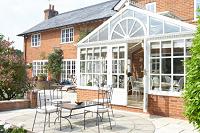
Conservatories and Rear Extensions

Benefits
- Increased living space
- A predominantly glazed structure brings the garden into your home particularly if you have a complimentary patio area
- A predominantly glazed structure offers an ambient light
Key Points
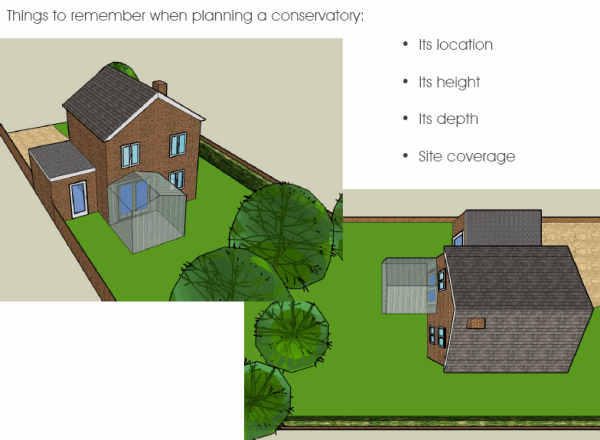
When planning a conservatory/single storey rear extension, the key points to think about are
- Site Coverage
Did you know that you will need planning permission if the proposed conservatory/single storey rear extension (when taken with existing extensions, outbuildings and decking for example), will cover more than 50% of the land around your home? - Location
In terms of location, if your property fronts a road and you wish to put an extension closer to that road than the principal elevation, you will need planning permission. - Height
Assuming the proposal is only single storey, its maximum height can be no more than 4 metres. Interestingly, if your proposal has an eaves and ridge height greater than that of your property, you will need planning permission. Also, if you are planning on putting an extension within 2 metres of a boundary, the eaves height cannot exceed 3 metres. - Depth
If you live in an attached house (say a terraced or semi-detached house for example), the maximum depth you cannot exceed is 3 metres and 4 metres in the case of detached house. - Veranda
You will require planning permission if you wished to add a veranda or raised platform to the structure. - Cladding
Last but not least, if your house occupies designated land, you cannot clad it. What this means is not entirely clear but we will attempt to interpret this in future articles.
Do I Need Planning Permission?
Planning Permission may not be required subject to the following limits and conditions:
- No more than half the area of land around the original house* would be covered by additions or other buildings.
- No extension forward of the principal elevation or side elevation fronting a highway.
- No extension to be higher than the highest part of the roof.
- Maximum depth of a single-storey rear extension of 3 metres for an attached house and 4 metres for a detached house.
- Maximum height of a single storey rear extension of 4 metres.
- Maximum depth of a rear extension of more than 1 storey of 3 metres including ground floor.
- Maximum eaves height of an extension within 2 metres of a boundary of 3 metres.
- Maximum eaves and ridge height of extension no higher than existing house.
- Side extensions to be single storey with maximum height of 4 metres and width no more than half that of the original house.
- Roof pitch of extensions higher than 1 storey to match existing house.
- No verandas, balconies or raised platforms.
- On designated land* no permitted development for rear extensions of more than 1 storey; no cladding of the exterior; no side extensions.
* The term "original house" means the house as it was first built or as it stood on 1 July 1948 (if it was built before that date). Although you may not have built an extension to the house, a previous owner may have done so.
* Designated land includes national parks and the Broads, Areas of Outstanding Natural Beauty, conservation areas and World Heritage Sites
Do I Need Building Regulations?
For a Conservatory, you will not require Building Regulations when
- It is less than 30 square metres in floor area and is built at ground level
- at least half of the new wall and three quarters of the roof are either glazed or translucent material
- the conservatory is separated by external quality door(s)
- glazing and fixed electrical installations comply with the applicable building regulation requirements
When planning where to locate a conservatory, it is advised not to construct conservatories where they will restrict access to windows serving rooms in roof or loft conversions, particularly if those windows are intended to help escape or rescue in the event of a fire.
What is important to remember is that if you intend to create a structural opening between the conservatory and the existing house, you will require building regulation approval for the opening, even if the conservatory is considered an exempt structure.
For a single storey rear extension, you would require Building Regulations.
Who can help me?
Please enter your postcode to find businesses local to you: